
How Do You Know?
What a neuroscientist's conversations with the unconscious reveal about a law we think we understand

Introduction
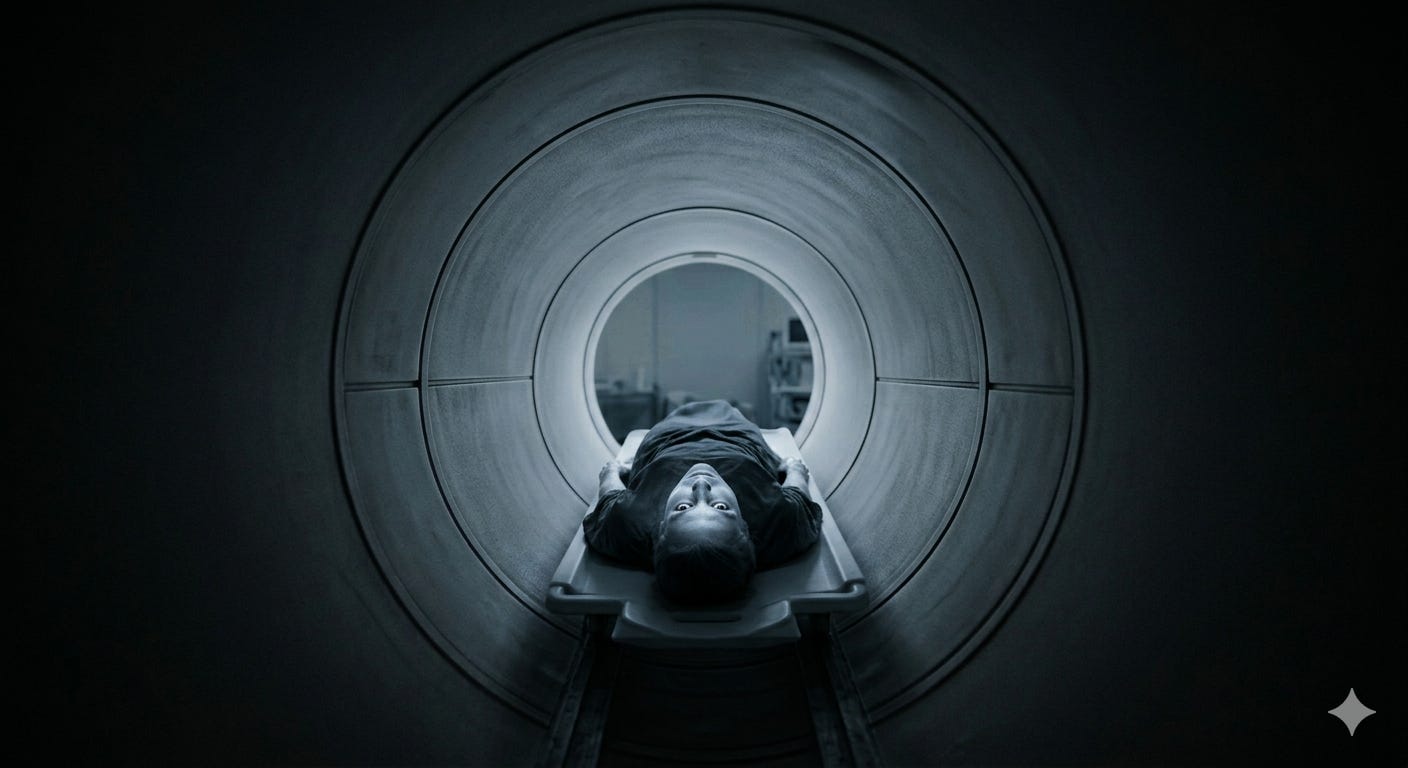
What does it feel like to be conscious but unreachable? To have thoughts, feelings, and responses that the world around you cannot detect? To be present, but invisible?
A few weeks ago I had an experience that brought those questions into sharp focus. I woke — or half-woke — into sleep paralysis. I was conscious. I knew where I was. I tried to move and found I could not. I tried to shout and produced almost nothing. The experience lasted perhaps a minute. It left me unsettled for the rest of the day.
That small, temporary, recoverable experience is the thread that runs through this article. Because what I experienced for a minute, some people experience permanently. And unlike me, they have no guarantee of waking up. Unlike me, the people around them have often concluded — with institutional authority and the best of intentions — that there is nobody there to wake.
This article is about those people. It is about a neuroscientist who found a way to reach them. And it is about a law that, despite its good intentions, may not be as protective of the vulnerable as it claims to be.
Sleep Paralysis
A few weeks ago, I had one of those weird, unsettling dreams that we sometimes have. I was asleep (I think) and I became aware that I wanted to wake up and I couldn’t. I tried to move my legs and I’m pretty sure I was somewhat successful. My gentle stretches became violent kicks. When I did wake up, my duvet was all over the place.
I also tried to shout. The more I tried to shout, the more difficult it became. The louder I tried to shout, the quieter the noise I made.
When I woke up, I felt very unsettled. The experience of being unable to wake up, however hard I tried, was itself unsettling. This feeling persisted throughout most of the day.
I think this is a common experience. I perhaps need to amend my first sentence. To be more accurate, I think I’d had a dream, and I was now in the liminal zone between dreaming and waking. I was experiencing a type of sleep paralysis, although in this instance, I was coming out of the paralysis itself.
Sleep paralysis occurs at the boundary between REM sleep and waking. As well as an inability to move, people can experience pressure on their chests and the sense of a malevolent presence. There is a rich and consistent supernatural folklore from many cultures on sleep paralysis that may explain experiences like visiting incubi and succubi, the Japanese kanashibari and alien abduction.
I’d guess that for most people, the experience of sleep paralysis is a lot like mine: at the very least unsettling and perhaps for some, quite terrifying. The worst thing, I’d suggest, is that when you experience sleep paralysis, you are conscious. And yet you cannot move or communicate.
For a moment, just try to imagine the experience. You know you are not dreaming. What you are experiencing is real. You’re conscious. You’re telling yourself that you need to move.
You may even be aware that you might be experiencing sleep paralysis. You can’t be absolutely sure, though, can you? Could it be something else? Something more serious? You try to move. You are willing yourself to move. You can feel your arm. You know your arm is where it should be. You can feel a tension as you try to move your arm. But nothing happens.
Finally, you wake up. How long was your sleep paralysis experience? A few seconds? A minute? Several minutes? Longer? You can’t tell. But it’s over now. It’s over, apart from the unsettled state you’ve been left in.
Now imagine that you can’t wake up!
Tony Bland
The weekend of April 15 and 16, 1989, should have been one of the great sporting spectacles of the English sporting year. Instead, it is remembered as one of the most devastating disasters associated with world sport.
On Sunday, April 16, Everton would play Norwich City at Villa Park in the second of the weekend’s FA Cup semi-finals. The day before, Saturday, April 15, Liverpool would play Nottingham Forest at Hillsborough Stadium.
On Saturday, April 15 poor crowd control led police to open an exit gate, allowing too many fans into already overcrowded standing pens. Supporters were crushed against perimeter fencing. Ninety-seven Liverpool fans died and hundreds were injured. Later investigations found major police failures were responsible.
Four years later, the 96th victim died. His name was Tony Bland. He was 18 years old when he went to the semi-final at Hillsborough. Tony suffered severe oxygen deprivation when he was crushed in the crowd. He was taken to hospital and diagnosed as being in a persistent vegetative state (PVS). In 1993, the House of Lords (at the time the highest court in England) gave permission for artificial feeding and life support to be withdrawn.
The important jurisprudential and ethical point in the case was the difference between active and passive euthanasia. Active euthanasia was and remains illegal under English law. Active euthanasia is intentionally doing something that causes death – giving a lethal injection, for example.
Passive euthanasia, on the other hand, might in some cases be legal. Passive euthanasia would include withdrawing or withholding medical treatment which allows someone to die.
The question was whether stopping feeding was withdrawing medical treatment. The House of Lords decided that it was. Therefore, Tony’s doctors were allowed to stop his feeding. Importantly, withdrawing his feeding would lead to Tony’s death, but it would not be the cause of his death. Tony’s official cause of death was bronchopneumonia, which developed after he was in a persistent vegetative state caused by severe hypoxic brain injury.
I recall Tony Bland’s case very well. One of the debates was whether Tony would suffer any pain as his organs shut down following the stopping of his feeding. The argument went something like this. Tony could not suffer hunger, pain, or distress. Tony was in a persistent vegetative state which meant that he was not conscious, had no awareness, and had no capacity for suffering. That was pretty much the received view of PVS at the time.
I remember a debate at the time. One expert put forward the received view. He was adamant that people in a PVS lack consciousness and awareness.
One of the other participants in the debate asked, “How do you know?”
The expert had no answer.
The Mental Capacity Act
That question “How do you know?” resonated deeply with me 35 years ago. It still resonates with me today. I am very much a sceptic. We should never just accept what we are told. We should always question. Always. Always. Always question.
Our history is littered with examples of the accepted view, the orthodox view, the received view being overturned. The earth was once the centre of the universe; we thought that continents were immovable; we thought anything heavier than air would never fly, and bloodletting undoubtedly killed more people than it cured. They were our beliefs until someone thought differently.
I’ve written several Substack posts about the Mental Capacity Act 2005. The Act troubles me. I think it is poorly understood. The test for capacity is very much based on the Western rationalist tradition – I’ve always believed that there are different rationalities. Perhaps my main concern, though, is that the Act can be all to easily weaponised as a prescription for paternalism in the name of protecting the vulnerable.
The functional test says that you will lack capacity if you can’t:
1. Understand information relevant to a decision,
2. Retain the information,
3. Use or weigh the information, and
4. Communicate your decision.
For the purpose of this article, let’s stick with communication. The code of practice says that it will be rare that there will be a communication failure. In practice, it seems to me, that this nudges assessors to find incapacity because of a failure of one or more of the first three criteria.
An important thing with communication is that assessors must be able to recognise communication where it exists. This places the onus on the person being assessed to communicate in a way that an assessor will recognise. That may not be quite so easy. There is undoubtedly an assumption that people with cognitive challenges – particularly if the conditions causing those challenges are advanced – are likely to find communication lying on a spectrum between very difficult and impossible.
And what about people in permanent vegetative states?
The Grey Zone
I doubt that there has ever been an attempt to assess the capacity of someone who has been diagnosed as being in a persistent vegetative state. I can’t verify that assertion. But why would you attempt such an assessment if the person in a PVS has no consciousness or awareness? Therefore, he or she would seem to fail each of the four criteria of the functional test.
But what if someone in a PVS could understand and communicate?
If that were possible, it seems to me that it must radically change how we view mental incapacity.
If it were possible. But how do you communicate with someone in a PVS?
Let me tell you about a book I discovered recently. It would be going too far to suggest that reading it changed my life. It did, however, give me a lot to think about. The book is called Into the Grey Zone by Adrian Owen. It’s extraordinarily well written, considering it deals with a highly technical subject: communicating with people in permanent vegetative states.
Owen suspects the question simply didn’t reduce to a clean yes or no — the honest answer for most people would be something like “it depends on the prognosis” or “give me time to think about it” — and that complexity produced unreadable activity.
This is the most extraordinary part of Owen’s book. It is impossible to put yourself into John’s position. He’s been in a PVS for a number of years — and remember, he is conscious and aware. Suddenly, he’s in an fMRI machine being asked if he wants to die!
Owen then devotes a whole chapter to the implications. Even if John had answered yes, he argues, it would have changed almost nothing legally. Society doesn’t permit assisted dying on the basis of a single expressed wish, and a yes from a brain scanner would face the same scepticism as a yes from anyone else — is it transient? Is it depression? Could it change? The technology had arrived at the question before the law, the ethics, or medicine had any idea what to do with the answer.
Owen is a neuroscientist who has spent a considerable amount of time working on how to communicate with people in PVS. The full story is well worth reading. I’m just cutting to the denouement.
Owen started with healthy volunteers. The volunteers had their brains scanned in an fMRI machine. Whilst in the machine, they were asked—Owen and his team were able to communicate with them—to imagine two things. First, to imagine playing tennis, and next, to imagine walking around their home.
When asked to imagine playing tennis, the supplementary motor area (SMA) lit up. This is the region of the brain associated with planning and imagining physical movement.
When asked to imagine walking through their home, the parahippocampal gyrus, the posterior parietal cortex, and the lateral premotor cortex lit up. These regions are associated with spatial navigation and environmental memory.
With different areas of the brain lighting up when volunteers imagined different things, it now became possible to ask yes or no questions. If the answer was yes, for example, the volunteers imagined playing tennis. If the answer was no, they imagined walking around their homes.
The question now was whether the same procedure could be used with people in persistent vegetative states. I guess one of the biggest surprises is that Owen’s research shows that some people in PVS are conscious and aware and are capable of communication. Owen estimates that perhaps one in five people in PVS may be conscious.
Owen and his team continued to refine the procedure. There is one case that Owen discusses where, using the yes-or-no questioning technique, he was able to ask someone in a PVS if he was in pain. He answered no. The man’s name was Scott. He was asked, “Scott, are you in any pain? Do any of your body parts hurt right now? Please imagine playing tennis if the answer is no.”
So, if we can communicate with around 20% of people in PVS, should we ask them if they wish to continue with their lives? Owen got the chance to ask this. The patient’s name was John. He was asked if he wanted to die. The result was inconclusive.
Owen suspects the question simply didn’t reduce to a clean yes or no—the honest answer for most people would be something like “it depends on the prognosis” or “give me time to think about it”—and that complexity produced unreadable activity.
This is the most extraordinary part of Owen’s book. It is impossible to put yourself into John’s position. He’d been in a PVS for a number of years—and remember, all this time he’d been conscious and aware. Suddenly, he’s in an fMRI machine being asked if he wants to die!
Owen then devotes a whole chapter to the implications. Even if John had answered yes, he argues, it would have changed almost nothing legally. Society doesn’t permit assisted dying on the basis of a single expressed wish, and a yes from a brain scanner would face the same scepticism as a yes from anyone else—is it transient? Is it depression? Could it change? The technology had arrived at the question before the law, the ethics, or medicine had any idea what to do with the answer.
The Mental Capacity Act Redux
The test of capacity involves a binary assessment. Either you are capacitous or you are not. I suggest that Owen’s work throws this assessment scheme into doubt. I believe with a passion that it is not the responsibility of those with intellectual challenges to come into our world: often they cannot. It is our responsibility to enter their world: Owen’s research shows that this may be possible more often than we believe.
The functional test is based on a particular model of decision making. John was unable to answer a question about whether he wanted to die. I would suggest that even very simple question may be too complex, sometimes, for a binary system. Being unable to communicate at a moment in time is not an inability to communicate. Not understanding information at a moment in time is not an inability to understand information.
Conclusion
The Mental Capacity Act was drafted with good intentions. It was designed to protect people who cannot protect themselves. But good intentions are not the same as good outcomes, and the road from protection to paternalism is shorter than its architects acknowledged.
Owen’s work forces a fundamental question: if we cannot reliably establish who is conscious, how can we reliably establish who lacks capacity? The two problems are not identical, but they share a root. Both rest on the assumption that absence of recognisable response is evidence of absence of inner life. Kate, Debbie, Scott, and John all gave the lie to that assumption. They were in there all along.
Think back to the sleep paralysis experience described at the beginning of this article. Conscious. Aware. Trying desperately to move, to shout, to make contact with the world outside. And utterly unable to do so. That experience lasted seconds, perhaps a minute. It left an unsettled feeling that persisted for most of a day. Now imagine that it never ended. Imagine that the inability to communicate was not a temporary glitch at the boundary of sleep and waking, but a permanent condition — and that everyone around you had concluded, on the basis of your silence, that there was nobody home.
The Mental Capacity Act asks whether a person can understand, retain, use, weigh, and communicate. These are reasonable questions. But they are questions that require recognisable answers — delivered in a form, at a moment, and through a medium that the assessor can identify. Owen’s research shows how fragile that requirement is. The method of assessment is not neutral. It carries within it assumptions about what communication looks like, what decision-making looks like, and what a person looks like when they are present. Those assumptions have already been proved catastrophically wrong in the most extreme cases. We should not be comfortable assuming they are reliable in less extreme ones.
How do you know?
Thirty-five years on, that question has only become harder to answer.